Free Printable Chinese Writing Paper
Here are nine sheets of Chinese writing paper as free PDFs, each in US Letter and A4: 田字格 (tián zì gé), 米字格 (mǐ zì gé) and tian zi ge with pinyin lines above each row, each in 20, 15 and 10 mm squares. You don't need to sign up or give us an email address. Pick a sheet, download it and print as many copies as you like, or make your own with the generator below.
Chinese writing paper goes by a few names: practice paper, writing grids, or simply 田字格 paper, after its most common grid. Whatever you call it, it does one job for anyone learning Mandarin Chinese: it keeps each character centered, balanced and the same size as its neighbors.
Tian zi ge paper (田字格)
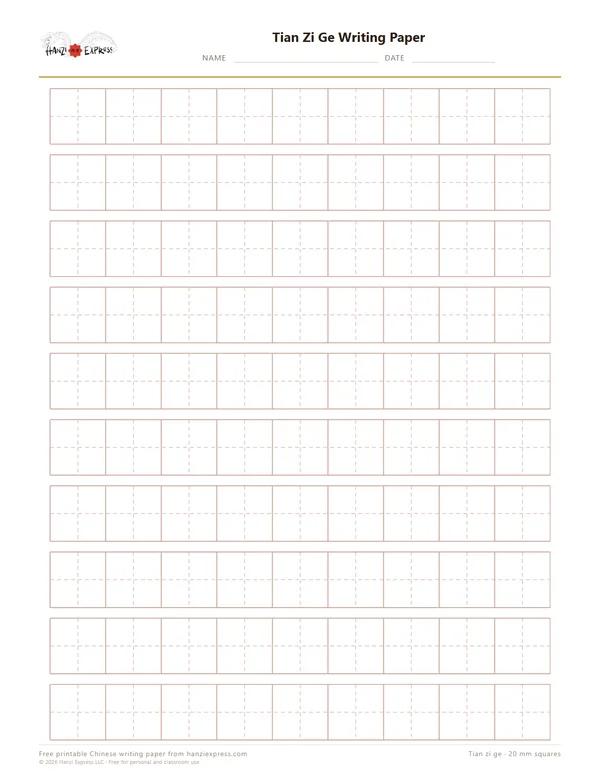
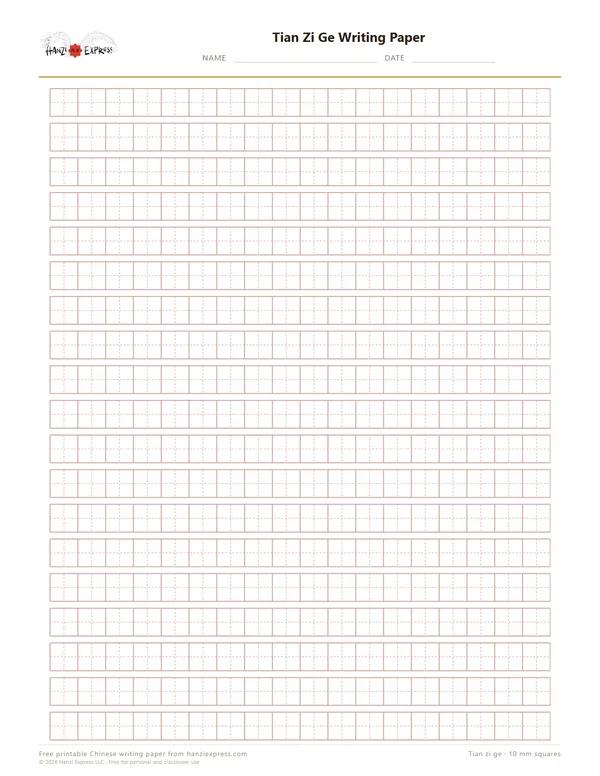
田字格 (tián zì gé, "field character grid") paper, with each square split into four quarters by dashed lines, as in many Chinese exercise books.
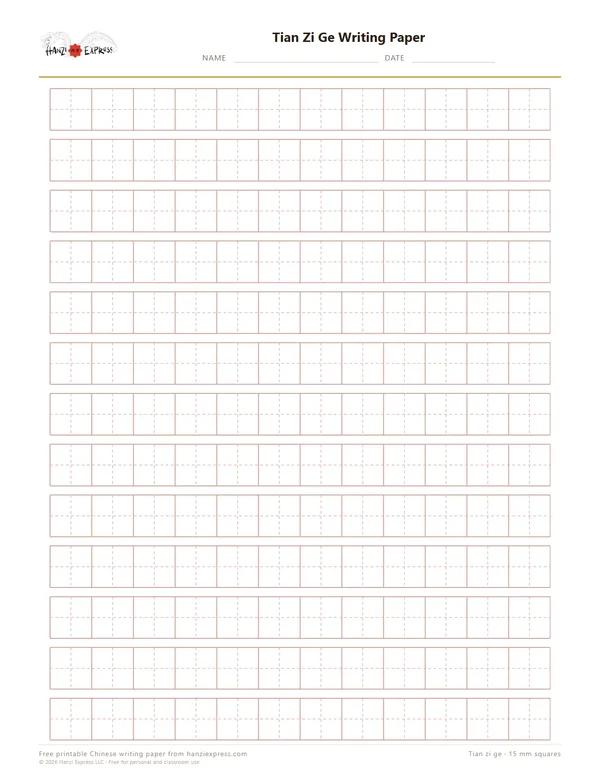
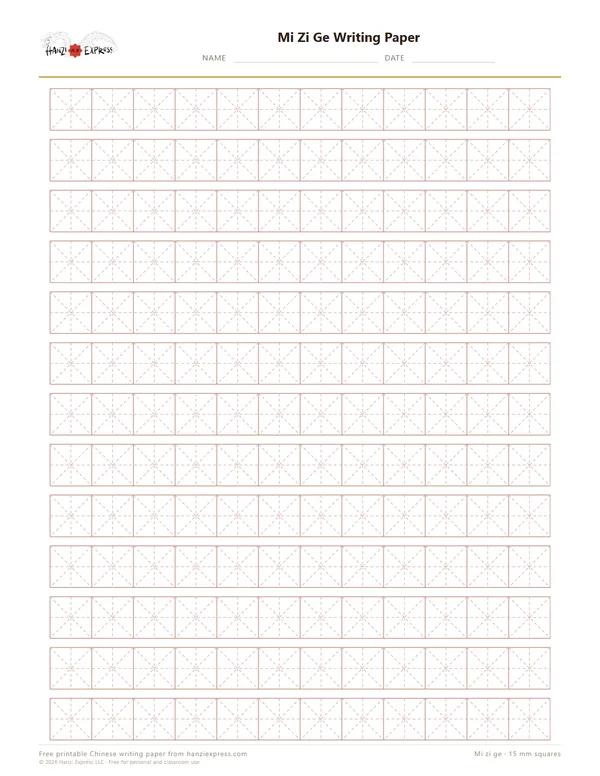
Medium: 15 mm squares
Everyday character practice
12 per row, 13 rows on US Letter, 14 on A4
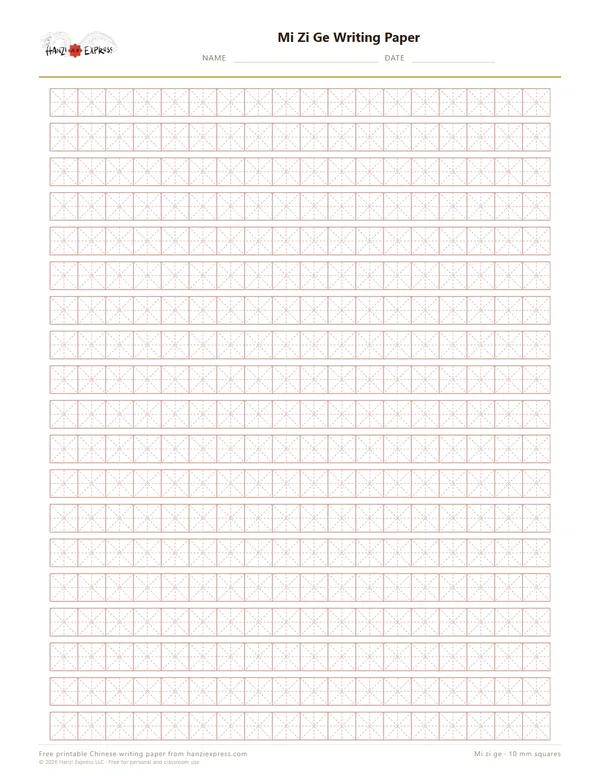
Mi zi ge paper (米字格)
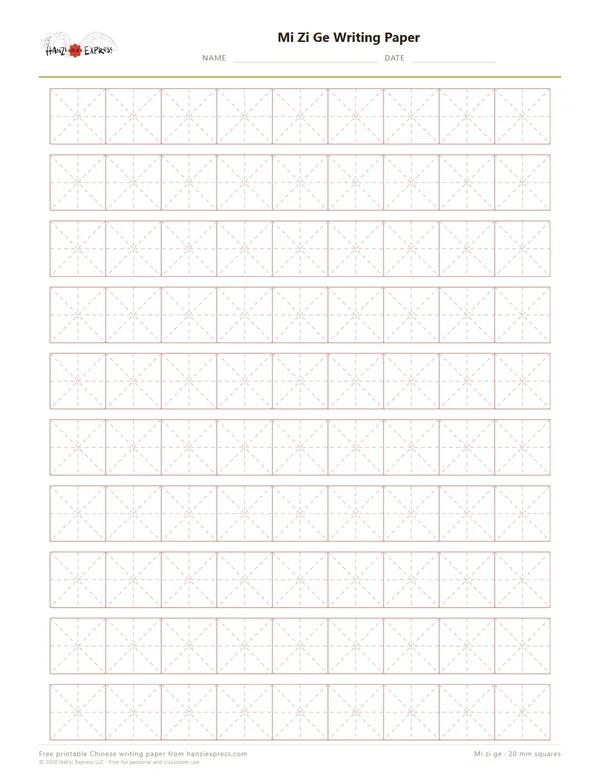
米字格 (mǐ zì gé, "rice character grid") paper, with the same quarters plus both diagonals, which together form the shape of 米 (mǐ, rice).
Large: 20 mm squares
Beginners and getting proportions right
9 per row, 10 rows on US Letter, 11 on A4
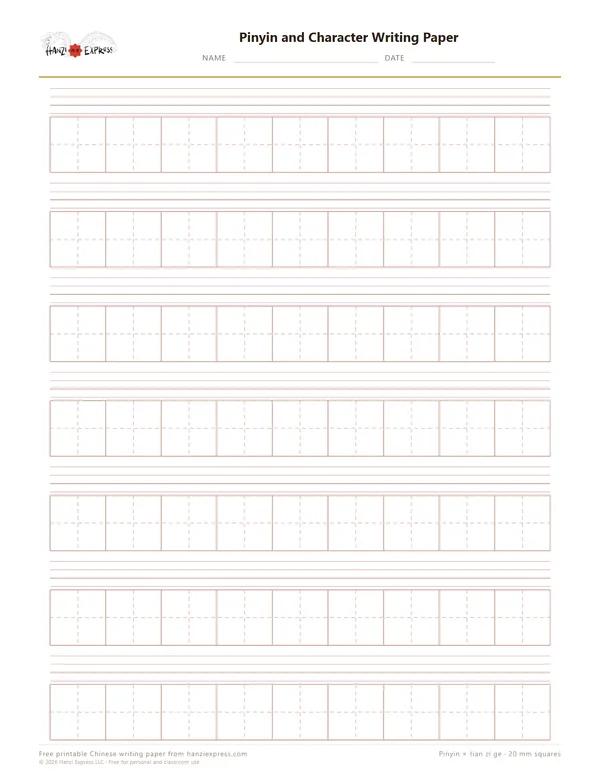
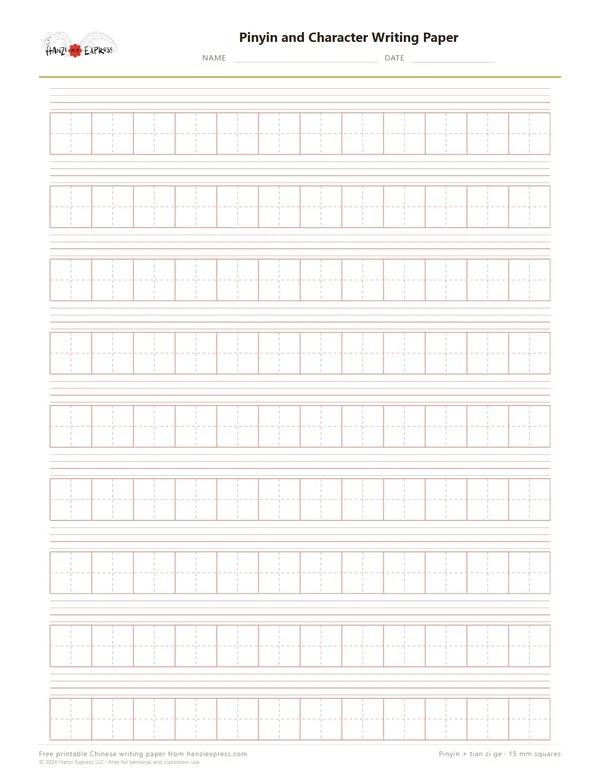
Pinyin writing paper (拼音田字格)
Tian zi ge with a four-line pinyin strip above every row, for writing the pinyin and tone marks over each character.
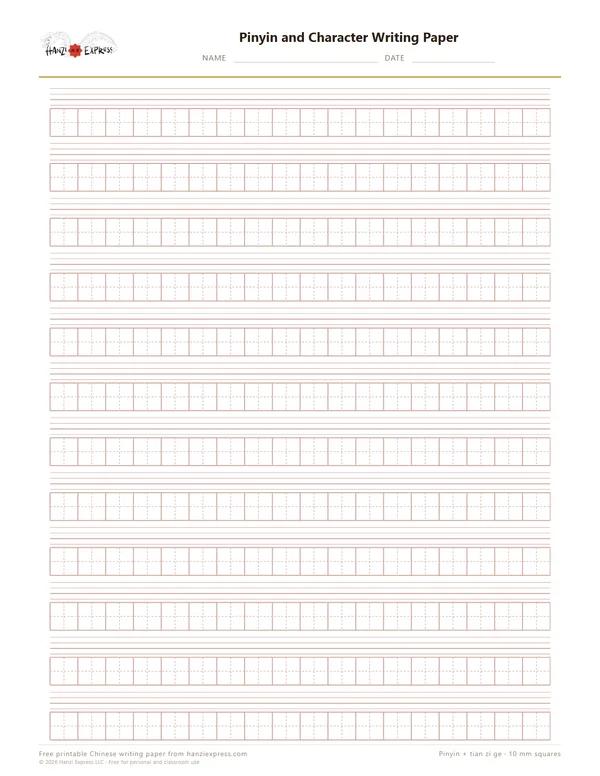
Tian zi ge generator: make your own sheet
Need a size or layout that isn't above? Choose the grid, any square size from 8 to 30 mm, pinyin lines and a line color. The preview is the sheet you will print, in the same design as the downloads.
12 squares per row, 13 rows (156 squares) on one page.
Print / Save as PDF
Which writing paper should I use?
Every design comes in the same three sizes, so pick the size first, then the grid.
- 20 mm, kids and beginners: room to get each stroke in the right place.
- 15 mm, everyday practice: also a good size for hard pen calligraphy, 硬笔 (yìng bǐ, "hard pen").
- 10 mm, dictation, sentences and compositions: for writers whose strokes are already steady.
Then the grid: tian zi ge for most practice, mi zi ge when diagonal strokes or balance are the problem, and the pinyin version when you want to write the pinyin above each character.
Tian zi ge vs mi zi ge
The difference is two lines. Tian zi ge divides each square into four quarters with one horizontal and one vertical dashed line, so it looks like 田 (tián, field). Mi zi ge adds both diagonals, and the lines meeting in the center look like 米 (mǐ, rice).
Tian zi ge is enough for most practice. The center lines show you where the middle of the character is and where left and right or top and bottom parts meet. Mi zi ge helps when diagonal strokes are the problem, as in 人 (rén, person) or 文 (wén, writing), and when you want to check a character's balance. That's why calligraphy practice often uses it.
How to use tian zi ge paper
Write each character centered in its square. Let it fill most of the square, with a small margin at the edges, so every character in a row comes out the same size.
The dashed lines are there to place strokes. In 十 (shí, ten), the horizontal stroke runs along the horizontal line and the vertical stroke along the vertical one. In 你 (nǐ, you), the left part 亻 (rén, the "person" radical) is narrow and stays left of the vertical line, while the right part takes the larger share of the square.
Before you write, look at where a model character's strokes cross the center lines, then copy those positions. Write the character along a whole row and compare the last one with the first.
Writing pinyin above the characters
The pinyin sheets put a four-line strip above every row of squares, like the lines children use to learn English handwriting. The four lines make three spaces. Letters like a, o and e fill the middle space, letters with ascenders such as b, d and h reach into the top space, and g, p and y drop into the bottom one. Tone marks go above the vowel.
Write the pinyin for each character directly above its square, so sound and character stay lined up. If you're not sure of a spelling or a tone, check it on our pinyin chart.
Printing tips
Download the version that matches your paper. US Letter is standard in the US and Canada; A4 is standard in most other countries. The squares are the same size in both, and on some sheets A4 fits one or two more rows because the page is taller.
In the print dialog, choose 100% or "Actual size". If the printer is set to "Fit to page", it shrinks the page slightly and the squares come out a little smaller than stated. The PDFs are vector files, so the lines print crisp on any printer. The guide lines are soft red, and in black and white they print as light gray.
Using the paper in GoodNotes, or as a notebook
The PDFs work in GoodNotes, Notability and other PDF note apps. Import the PDF as a template or notebook page, then duplicate the page whenever you need a fresh sheet. With a stylus you get the same grid as on paper, without running out of copies.
For a paper notebook, print a stack of sheets double-sided and staple or bind them along the edge. That gives you a tian zi ge notebook like the exercise books Chinese students use, in whichever square size you need.
Need a worksheet for specific characters?
This paper is blank on purpose. If you want sheets for particular characters, with stroke order, tracing and model characters, use our free Character Worksheet Generator. It has the same design as these sheets, with the Hanzi Express logo, a Name and Date line and the same soft red guide lines, so the pages match. If you're deciding which characters to learn, the HSK 3.0 character lists are a good place to start.
Frequently asked questions
Is this Chinese writing paper free?
Yes. All 18 PDFs are free to download, with no signup and no email address. You can use them at home or in class and photocopy them as often as you need.
What is tian zi ge paper?
田字格 (tián zì gé) means "field character grid". Each square is divided into four quarters by dashed lines, which makes it look like the character 田 (tián, field). The lines help you place strokes and keep your characters centered and the same size.
What's the difference between mi zi ge and tian zi ge?
米字格 (mǐ zì gé) adds two diagonal lines to the tian zi ge grid. The diagonals help with slanted strokes and balance, so calligraphy practice often uses it. For everyday practice, tian zi ge is enough.
Can I make my own tian zi ge paper?
Yes. The generator on this page lets you choose tian zi ge, mi zi ge or plain squares, any square size from 8 to 30 mm, pinyin lines, the line color and the paper size. Print it, or save it as a PDF from the print dialog.
Can I use this paper in GoodNotes?
Yes. Import the PDF into GoodNotes, Notability or another PDF note app as a template or notebook page, and duplicate the page as often as you need.
Should I download A4 or US Letter?
Match the paper in your printer. In the US and Canada that's usually Letter, and elsewhere it's usually A4. Print at 100% or "Actual size" so the squares keep their stated size.
Which Chinese writing paper is right for kids?
The 20 mm squares, 9 per row. Large tian zi ge suits most children; the large pinyin version adds lines above each row for writing pinyin.